From Farm to Fork: Thermal Imaging Is the Food Industry’s New Secret Weapon for Safety and Quality
The journey of food from where it’s grown to the consumer’s plate is a complex and often delicate process. Any misstep can lead to spoilage, waste, and, most critically, serious food safety incidents. Traditional visual inspections and point-and-click thermometers have long been the industry standard for monitoring, but they have significant limitations.
Now, a technology once reserved for military and high-tech industrial applications is revolutionizing how food processors, manufacturers, and retailers ensure the safety and quality of the global food supply: high-resolution thermal imaging cameras.
Exothermic Reactions: Visualizing the Unseen
In the production of certain types of processed foods, chemical reactions are essential. Fermentation, a cornerstone of baking, brewing, and yogurt production, is an inherently exothermic process—it releases heat.
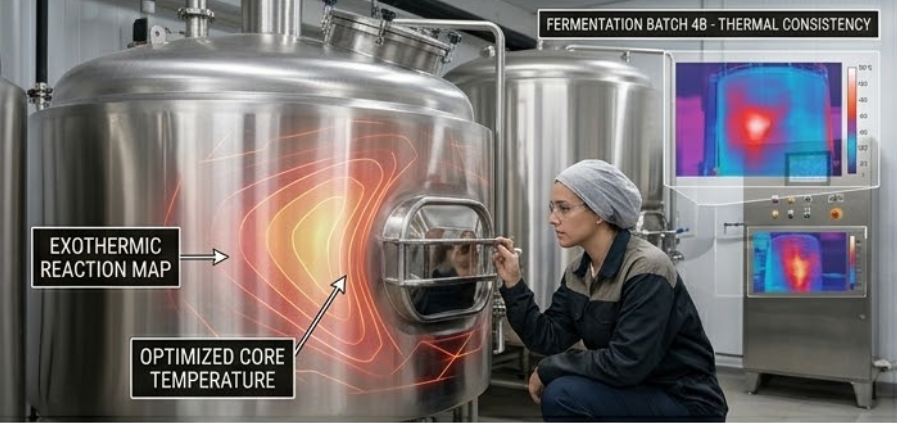
Traditionally, monitoring these reactions has been cumbersome. Thermocouples can provide a temperature reading for a single point, but they can’t show the distribution of that heat across an entire batch. For large-scale fermentation vessels, this means localized “hot spots” can form, potentially spoiling the entire batch or affecting the consistency of the final product.
“With thermal imaging, we are no longer flying blind,” says Dr. Eleanor Vance, a food science research director. “We can look at a massive vessel and instantly see a complete, real-time visual map of the entire exothermic reaction. We can pinpoint hot spots that point-sensors would miss completely. It’s an absolute game-changer for process control.”
Integrity Inspections: The Vessel Whisperer
Chemical and ingredient storage vessels, a common sight in food manufacturing, are critical infrastructure. They are often lined with specialized refractory materials or protective coatings to withstand corrosive substances and high-temperature processes. If this lining fails, the structural integrity of the vessel is compromised.
Traditionally, inspecting the internal lining of these massive vessels was an expensive and time-consuming process requiring shutdown, entry, and extensive manual checks.
Thermal imaging enables non-contact, “through-the-wall” monitoring of these vessels. By visualizing the surface temperature anomalies, operators can detect signs of refractory degradation, localized hot spots, or sediment buildup in real-time. This predictive maintenance allows companies to identify and address internal problems before they lead to expensive structural failure or product contamination, keeping operations running smoothly.
Leak Detection and Prevention
A leak in a food processing or storage facility, even a small one, is a serious threat. It can be a simple loss of valuable product (like milk, juices, or syrups), but it can also involve hazardous materials. For instance, methane and other volatile compounds are often associated with food waste management and processing, while ammonia is a common refrigerant in massive food cold-storage systems.
Leaking fluids and, crucially, gases are often invisible to the naked eye. Because they undergo a change in temperature as they change state or pressure, they create a distinct thermal signature. Advanced Optical Gas Imaging (OGI) thermal cameras are now specifically tuned to visualize leaks of hazardous compounds like methane or ammonia as distinct, cold or warm plumes, allowing maintenance teams to pinpoint the leak’s exact source from a safe distance, instantly.
Energy Efficiency and Cost Savings
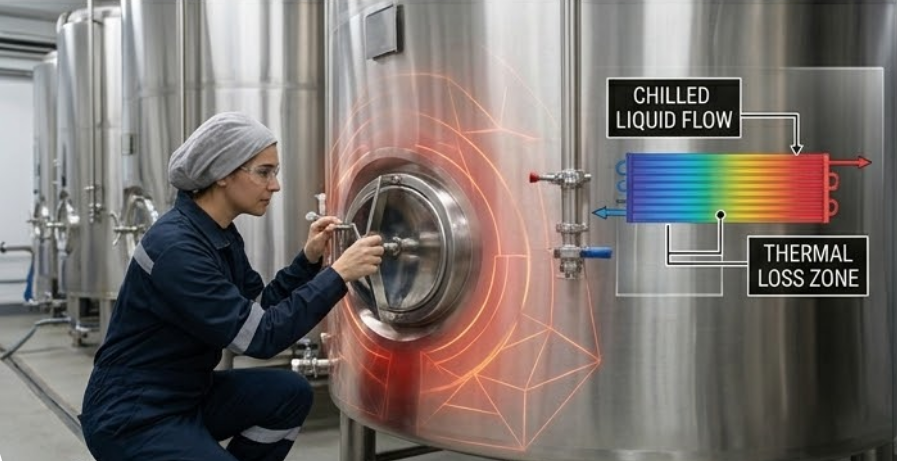
Beyond safety and process control, thermal imaging is a vital tool for improving sustainability and energy efficiency, key goals for modern food processors. Systems like distillation columns and complex heat exchangers are incredibly energy-intensive. Thermal inspections can instantly reveal “short-circuiting” or blockages in heat exchangers or gaps in the insulation on steam lines.
By identifying and fixing these “thermal leaks,” food processing plants can significantly reduce their carbon footprint and slash their operational energy costs.
Preventing a Catastrophe: Fire and Explosion Prevention
In facilities where volatile organic compounds (VOCs) or fine powders are processed (such as flour mills or sugar plants), the risk of fire and explosion is a constant concern. A single, undetected hot spot on a motor, pump, or electrical panel can provide the ignition source for a catastrophic event.
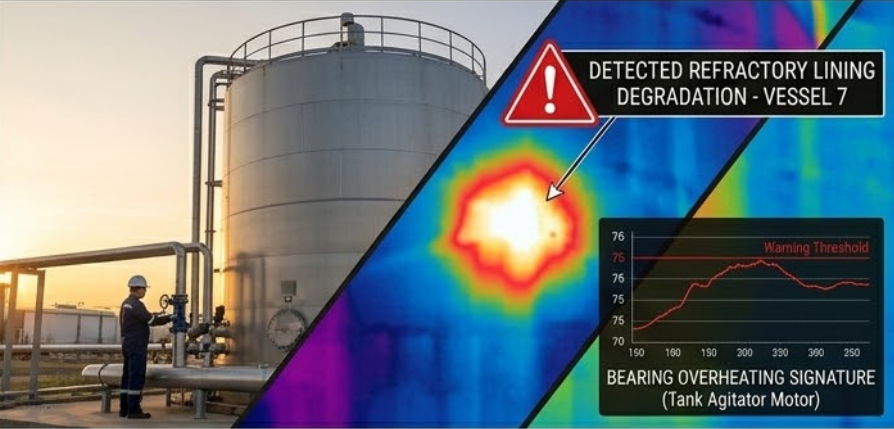
By integrating automated thermal monitoring systems with real-time alarms, food processing plants can move from reactive to proactive maintenance. These fixed thermal sensors can continuously scan critical equipment 24/7, long before a component fails or an electrical fault can spark a disaster. The system can send an alert for preventative intervention, ensuring the safety of the workforce and the environment.
Conclusion
The food industry is rapidly moving toward a future of “Industry 4.0,” and the integration of smart infrared thermal imaging technology is quickly becoming the standard. In an industry where trust and consistency are paramount, this ability to visualize the unseen is providing a crucial new layer of confidence for food safety, process quality, and sustainable, efficient operations.