Application of thermal imaging technology in HVAC/R maintenance
Infrared Thermography is the “gold standard” for diagnostics and efficiency analysis in the HVAC/R (Heating, Ventilation, Air Conditioning, and Cooling) field. It transforms invisible temperature differences into visual images, helping technicians quickly pinpoint faults without damaging the building structure.
Here are the main application scenarios for thermal imagers in HVAC/R:
1. Building Envelope and Energy Loss Detection The most intuitive use of thermal imagers is detecting “energy leaks” in buildings.
Missing Insulation: Easily identifies missing, damp, or settled insulation in walls or ceilings.
Air Leaks: During seasonal transitions, detects air leaks caused by gaps in doors and windows, attic entrances, or aging weatherstripping due to indoor and outdoor temperature differences.
Thermal Bridge Effect: Identifies areas of high thermal conductivity in the building structure (such as metal frames), which can lead to significant energy loss.
2. Duct and Ventilation System Inspection Ventilation ducts are often hidden behind ceilings or walls, making manual inspection extremely difficult.
Duct Leaks: During air conditioning operation, thermal imaging can clearly show the path of cold/hot air leakage caused by detached or damaged duct joints.
Airflow Balance: By measuring the temperature distribution at the air outlets, it can determine whether the airflow distribution in each area is uniform, assisting in the adjustment of the balancing valve.
3. Air Conditioning and Refrigeration Unit Diagnosis
For core components such as compressors and condensers, thermal imaging can prevent catastrophic equipment failures.
Refrigerant Leaks: Abnormal temperature differences on the evaporator or condenser coils often indicate insufficient refrigerant charge or blockages.
Compressor Failures: Check the compressor casing temperature, discharge pipe temperature, and valve condition. Overheating usually indicates poor lubrication or internal mechanical wear.
Condenser Efficiency: Check whether the condenser fins are blocked by dust; thermal imaging will show “blind spots” of uneven heat dissipation.
4. Electrical System and Control Logic Inspection
More than half of HVAC system failures originate from electrical problems.
Overheating Wiring: Identify loose terminals, overloaded contactors, or aging circuit breakers within the control cabinet.
Motor Monitoring: Check the bearing temperature rise of blower and pump motors to prevent motor burnout.
5. Hydraulic System and Underfloor Heating Inspection
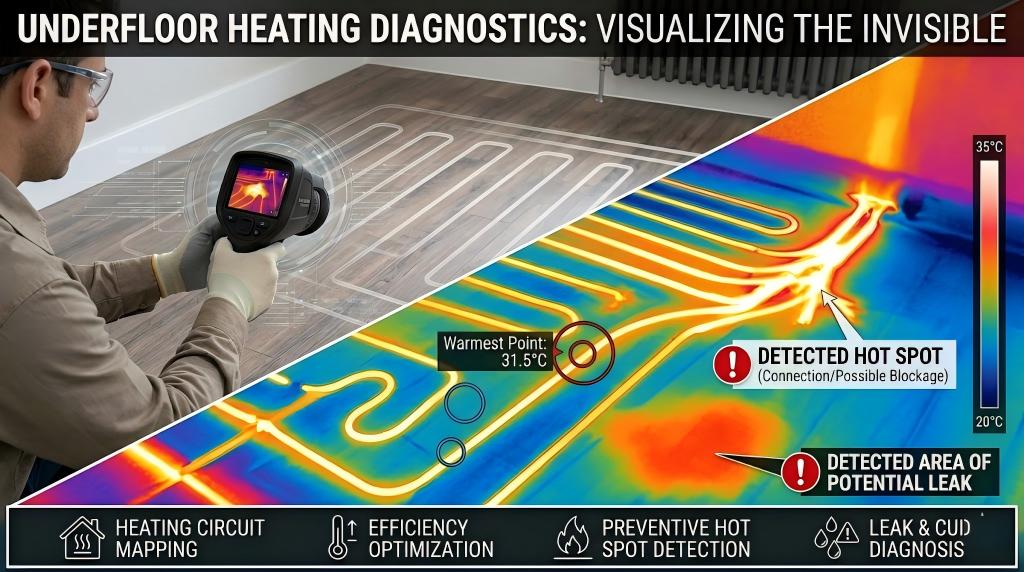
Underfloor Heating Location and Leaks: Underfloor heating piping diagrams can be accurately drawn without prying up the floor. If a leak occurs, the thermal image will show a distinct “heat halo” area.
Steam Trap Inspection: In steam systems, thermal imagers can quickly determine whether a steam trap is in normal working order, normally open (wasting steam), or normally closed (condensation buildup).