Driving Beyond the Visible: The Role of Thermal Imaging in Modern Vehicles
In the rapidly evolving landscape of automotive technology, the quest for absolute safety and reliable autonomous driving has moved beyond standard CMOS cameras and LiDAR. While traditional sensors rely on visible light or laser reflections, Infrared Thermal Imaging offers a unique advantage: the ability to “see” heat.
As a leading manufacturer of high-performance thermal imagers, we examine how this technology is becoming a critical component of the modern vehicle’s sensory stack.
1. Advanced Night Vision Systems (NVS)
The most direct application of thermal imaging in vehicles is Passive Night Vision. Unlike active systems that use infrared emitters (which have limited range), thermal cameras detect the natural heat signatures of humans, animals, and other vehicles.
Long-Range Detection: Thermal sensors can detect a pedestrian up to 300 meters away, far exceeding the reach of standard high-beam headlights.
>Anti-Glare: Unlike traditional cameras, thermal imagers are unaffected by the blinding glare of oncoming headlights or streetlamps, ensuring a clear “thermal path” at all times.
2. All-Weather Reliability for ADAS
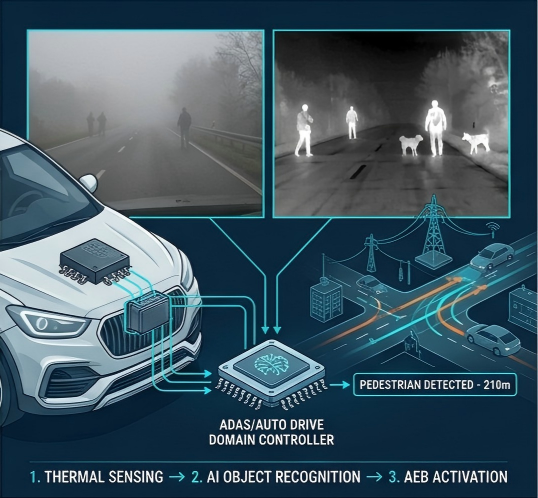
Advanced Driver Assistance Systems (ADAS) often struggle in adverse environmental conditions. Visible light cameras fail in heavy fog, smoke, or total darkness, while LiDAR can be hampered by heavy rain or snow.
Atmospheric Penetration: Long-Wave Infrared (LWIR) radiation penetrates smoke, light fog, and dust more effectively than visible light.
>Redundancy: Thermal imaging provides a crucial layer of “sensor fusion,” offering reliable data when other sensors are compromised, thereby reducing the “false negative” rate in emergency braking systems.
3. Pedestrian and Wildlife Detection (AEB Integration)
Automatic Emergency Braking (AEB) is only as good as its object recognition. Thermal imaging excels at High-Contrast Detection. Because living beings are significantly warmer than the asphalt or roadside vegetation, thermal sensors provide high-contrast input that simplifies AI algorithm processing for human and animal identification.
4. Integration via GMSL and High-Speed Interfaces
For modern automotive architectures, data transmission speed and low latency are non-negotiable. Integration of thermal modules—such as those utilizing GMSL (Gigabit Multimedia Serial Link)—allows for:
Real-time Processing: Low-latency thermal video feeds directly into the vehicle’s Domain Control Unit (DCU).
>SWaP Optimization: Compact thermal modules with optimized Size, Weight, and Power (SWaP) parameters allow for seamless integration into side mirrors, front grilles, or behind the rearview mirror.
5. The Future: Autonomous Driving (L3-L5)
As we move toward higher levels of autonomy, the “blind spots” of current sensor suites must be eliminated. Thermal imaging provides the thermal “intelligence” required for a vehicle to understand its environment in 24/7 conditions. It is no longer a luxury feature for high-end sedans but a foundational safety requirement for the autonomous fleets of tomorrow.
Conclusion
Thermal imaging is transitioning from a niche military-grade technology to a mainstream automotive safety standard. At Infraroadtech, we specialize in providing the high-sensitivity thermal hardware necessary to power these innovations, ensuring that vehicles can see the invisible and protect what matters most.